من ماسينيسا موحّد نوميديا إلى يوغرطة الذي تحدّى روما، ومن يوبا الأول آخر الملوك المستقلين إلى يوبا الثاني الملك العالم — خمسة ملوك أمازيغ حكموا شمال إفريقيا عبر ثلاثة قرون. لكل ملك لوحة خاصة به: صورته، نبذة عن حياته، وملخص عن عصره.
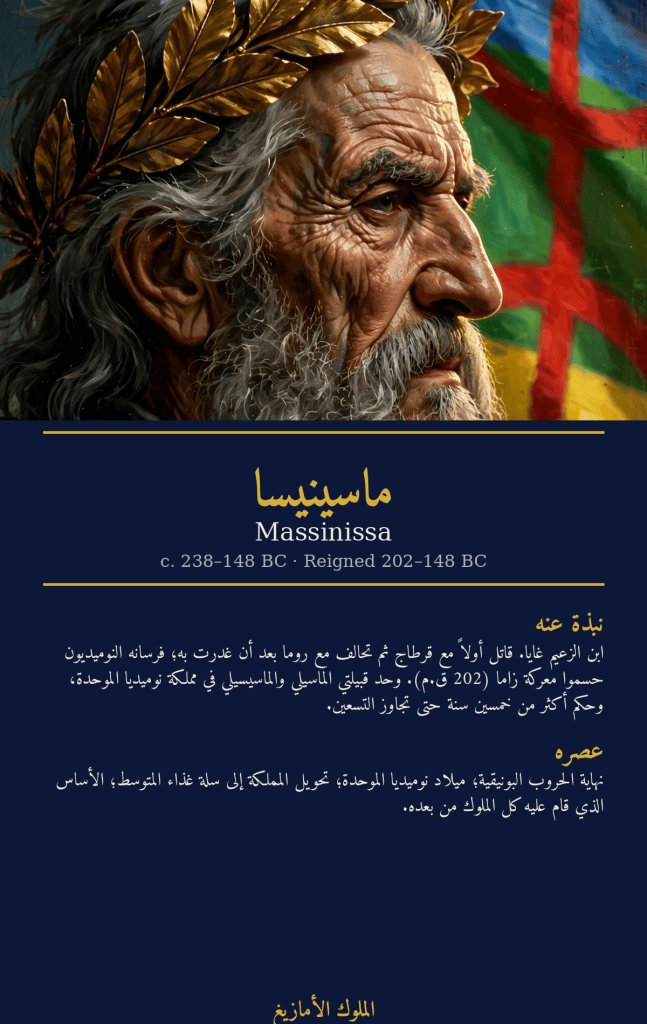
Massinissa — c. 238–148 BC, reigned 202–148 BC, first king of unified Numidia
Biography: Massinissa was the son of Gaia, chief of the Massylii tribe in eastern Numidia. As a young prince he first fought for Carthage against Rome in Spain, but after Carthage humiliated him — giving his promised bride Sophonisba to his rival Syphax — he allied with the Roman general Scipio Africanus. His superb Numidian cavalry decided the Battle of Zama (202 BC), ending the Second Punic War. Rome rewarded him with the whole of Numidia, uniting the Massylii and Masaesyli tribes into one powerful kingdom with its capital at Cirta (Constantine). He reigned over fifty years, turned Numidia into the breadbasket of the Mediterranean, and died around age 90.
His story: They say Massinissa once stood before the Roman Senate as an old man of eighty-eight, demanding justice against Carthage — and the senators, used to kings who begged, did not know what to do with a king who negotiated. When he died, he left behind not just a kingdom but an idea: that the Amazigh could be united under one crown. Every king in this article descends from him.
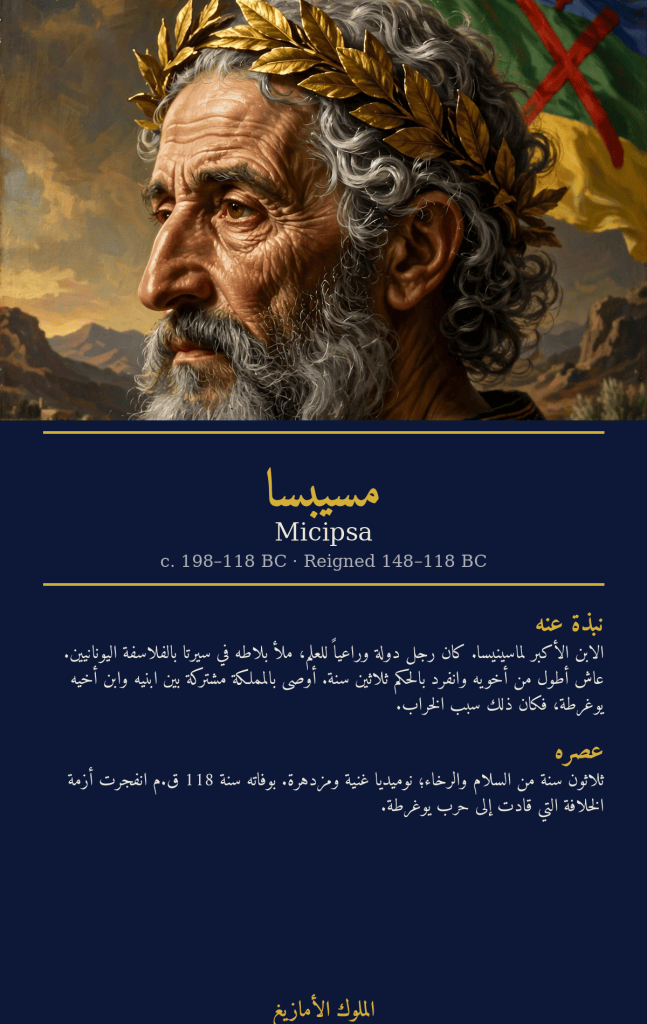
Micipsa — c. 198–118 BC, reigned 148–118 BC, son and successor of Massinissa
Biography: Micipsa was the eldest son of Massinissa. Where his father had been a warrior, Micipsa was a statesman and a patron of learning — he filled his court at Cirta with Greek philosophers and scholars. On Massinissa’s death the kingdom was divided among his three sons, but Micipsa outlived his brothers and ruled alone for nearly thirty years of peace and prosperity. His tragedy was his succession: his two sons Adherbal and Hiempsal were weak, while his nephew Jugurtha was brilliant, ambitious, and beloved by the army. Trying to be fair, Micipsa adopted Jugurtha and left the kingdom jointly to all three. He died in 118 BC; within a year, the kingdom was at war with itself.
His story: Micipsa is remembered as the king who loved books more than battles — and whose kindness destroyed his kingdom. On his deathbed, the old king reportedly called the three young heirs to his side and begged them to rule as brothers. The ink on the will was barely dry before Jugurtha’s agents were moving in the dark.
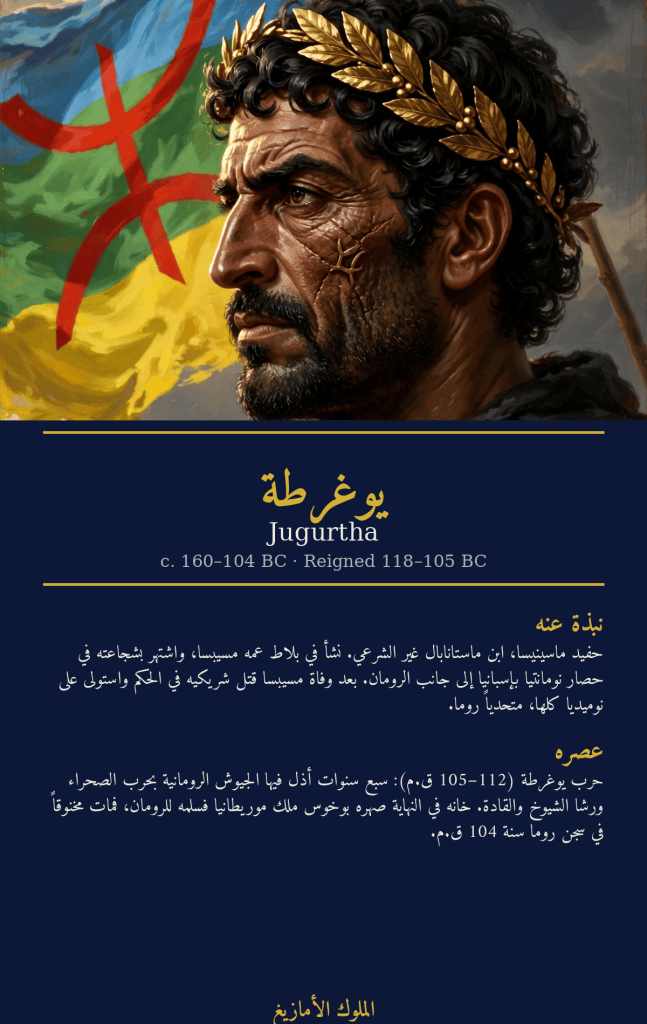
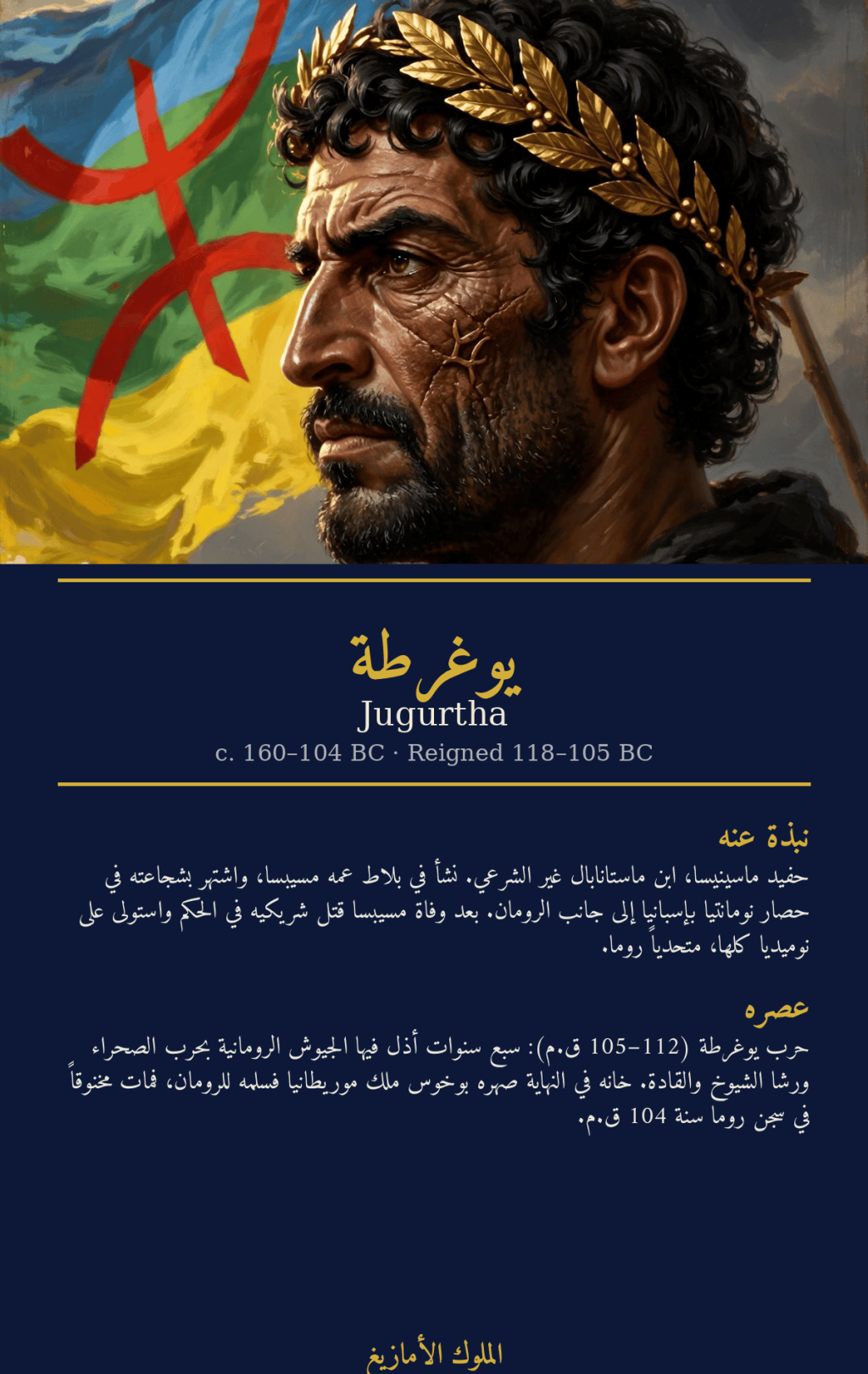
Jugurtha — c. 160–104 BC, reigned 118–105 BC, grandson of Massinissa; the king who defied Rome
Biography: Jugurtha was the illegitimate son of Mastanabal (Massinissa’s youngest son), raised at his uncle Micipsa’s court. He won fame fighting for Rome at the siege of Numantia in Spain, where he learned, in his own words, that Rome was “a city for sale, and doomed to fall if it finds a buyer.” After Micipsa’s death he seized all of Numidia. Rome declared war (the Jugurthine War, 112–105 BC). For seven years Jugurtha humiliated Roman armies with desert warfare and bribed senators and generals alike. He was finally betrayed by his own father-in-law, Bocchus I of Mauretania, who handed him in chains to the Roman general Sulla. Paraded in Rome, he was thrown into the dark Tullianum prison and strangled in 104 BC.
His story: No Amazigh king is more loved by his people than Jugurtha — who looked the Roman Empire in the eye and laughed. For seven years the greatest power on earth could not catch one desert king. In the end it was not Rome that defeated him but family: his father-in-law Bocchus invited him to a parley and sold him for a Roman alliance. He died in the dark — but his name became the eternal Amazigh symbol of resistance.
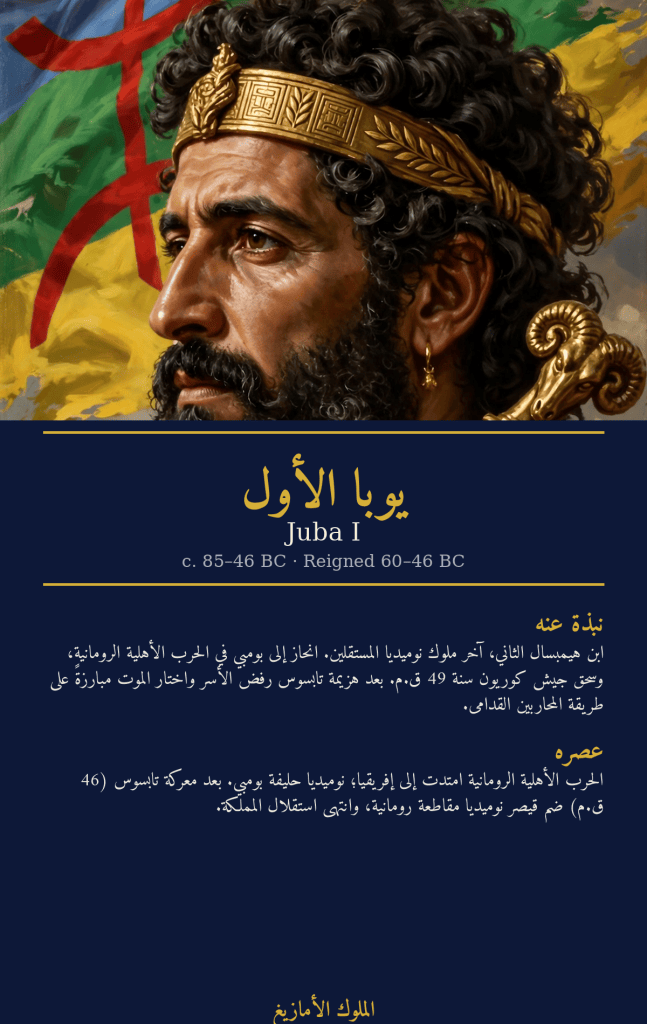
Juba I — c. 85–46 BC, reigned 60–46 BC, the last independent king of Numidia
Biography: Juba I, son of Hiempsal II, inherited a Numidia that was now a pawn of Roman politics. When Julius Caesar and Pompey tore the Roman Republic apart in civil war, Juba chose Pompey’s side — a fateful choice. In 49 BC he annihilated the army of Caesar’s general Curio, a stunning victory that made him the most feared African king of his age. But fortune turned: at the Battle of Thapsus (46 BC), Caesar crushed the Pompeian forces. Rather than be paraded in a Roman triumph, Juba fled with a Roman officer and, in the old warrior’s custom, the two fought a duel so that at least one would die free — Juba fell. Numidia was annexed as the Roman province of Africa Nova.
His story: Juba I had one moment of glory that Africa still remembers: the day he destroyed Curio. Caesar’s proud legate had marched into Africa certain that a “barbarian king” would run — instead Juba’s cavalry closed around the Romans like a fist, and Curio died on the field with his whole army. Juba would not give Rome the pleasure of his capture. He died as his ancestors had lived: free.
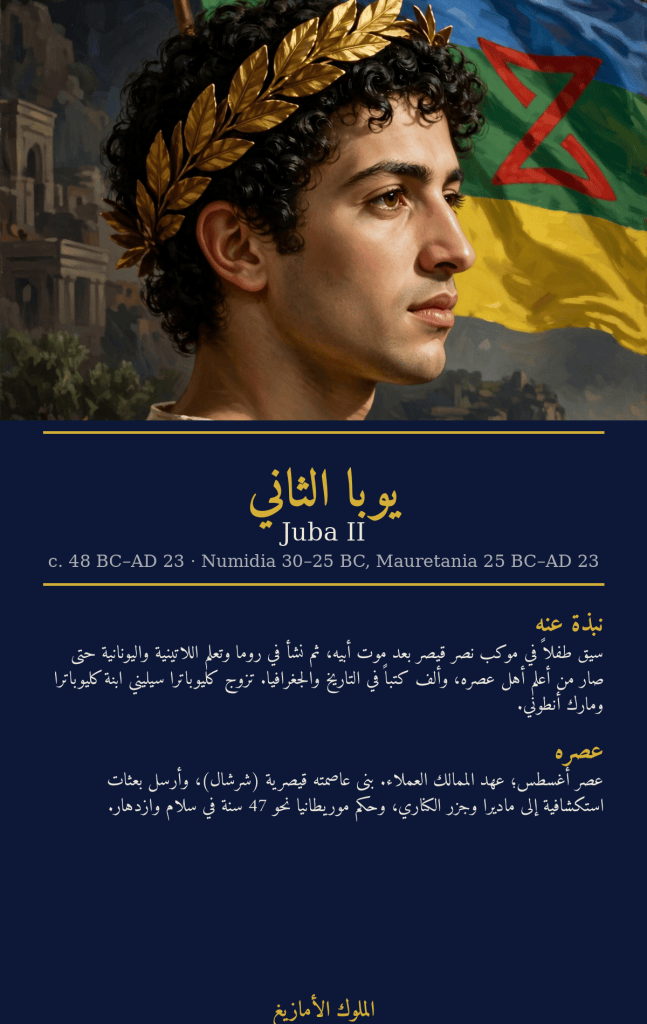
Juba II — c. 48 BC–AD 23, king of Numidia 30–25 BC, king of Mauretania 25 BC–AD 23; the scholar king
Biography: Juba II was only a small child when his father Juba I died at Thapsus. He was paraded in chains through Rome in Julius Caesar’s triumph — then, in one of history’s strangest turns, raised and educated in the imperial household itself. He learned Latin and Greek, became a Roman citizen, and grew into one of the most learned men of his age, writing books on history, geography, grammar, painting, and the theatre (Pliny the Elder cites him as an authority more than sixty times). Augustus restored him as a client king — first of Numidia, then of Mauretania, where he built the splendid capital of Caesarea (Cherchell, Algeria). Augustus married him to Cleopatra Selene II — the daughter of Mark Antony and Cleopatra VII of Egypt. He reigned peacefully for nearly fifty years, explored the Atlantic, and died of old age in AD 23.
His story: Imagine it: a boy in chains, dragged through Rome behind Caesar’s chariot while the crowds jeer — and forty years later, that same boy sits on a throne, married to the daughter of Cleopatra, corresponding with emperors, writing books that Rome’s scholars quote for centuries. Juba II never raised a sword against Rome; he conquered it with his mind instead. The warrior line of Massinissa ended not with a battle but with a book — and perhaps that was the greatest victory of all.


Leave a Reply